
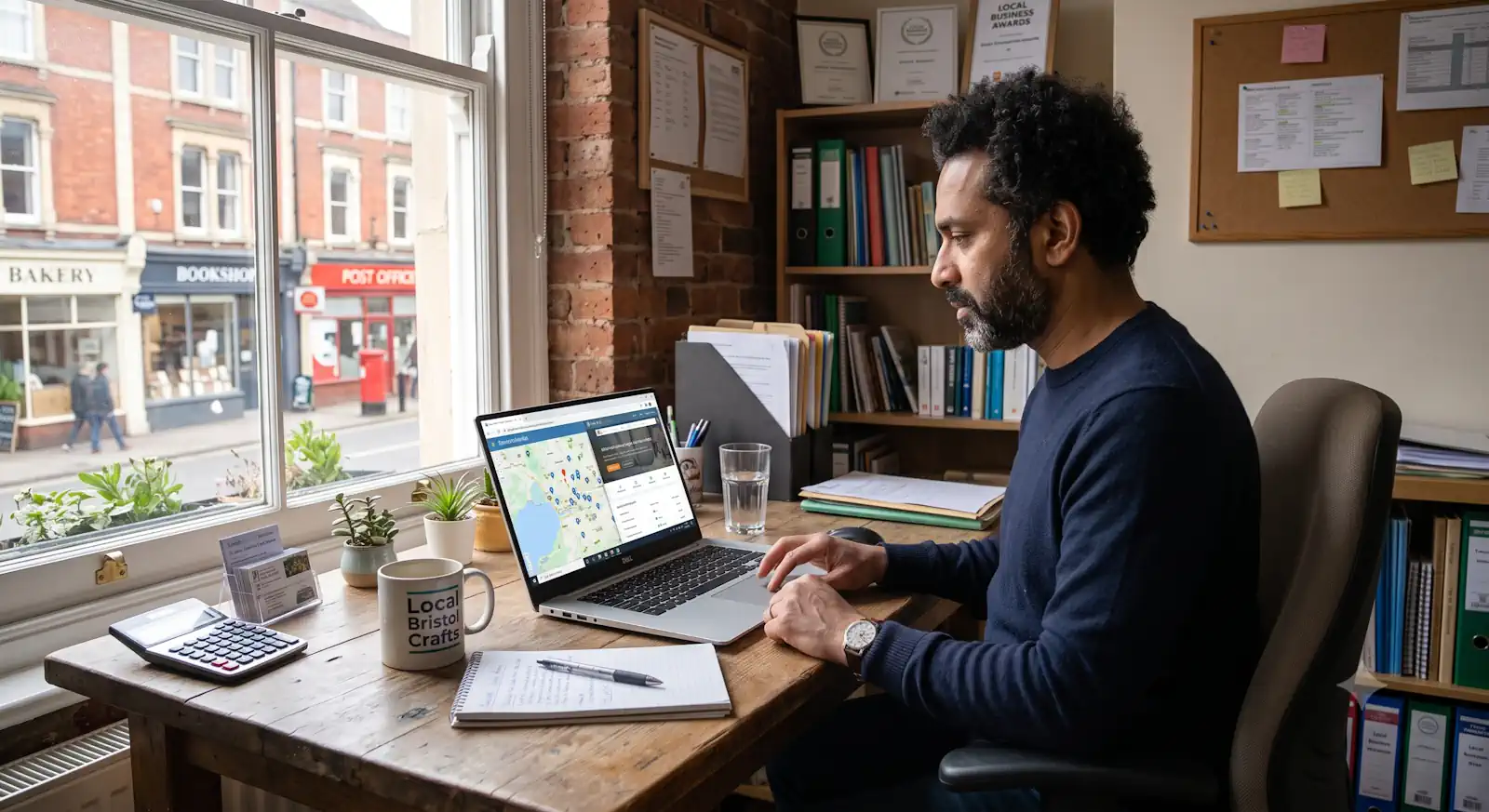
Organic growth can sound like something only large technology companies talk about. In practice, the same idea matters to a local accountant, roofer, dental practice, solicitor, café, clinic, estate agent or trades business.
It means earning visibility over time by being useful, clear and trusted. It is not about chasing every new tactic. It is about making it easier for the right people to find you, understand you and choose you.
For UK local businesses, that visibility now stretches across several places. People may find you through Google Search, Google Maps, your website, your Google Business Profile, review platforms, social posts, local directories or AI-powered search results. The job is to make sure all of those places tell a consistent and helpful story.
Organic growth starts with being easy to understand
Many local businesses make their marketing harder than it needs to be. They use broad phrases such as “quality service”, “trusted experts” or “solutions for your needs”. These may be true, but they do not help search engines, AI tools or potential customers understand what the business actually does.
A stronger approach is to be specific. Say what you do, where you do it and who you help. A local business does not need to sound clever. It needs to be clear.
For example, “family-run plumbing company in Swansea offering boiler repairs, bathroom installations and emergency call-outs” is more useful than “your local home improvement specialists”. It gives Google, AI systems and people more context.
This clarity should appear across your website, page titles, service pages, Google Business Profile, image descriptions, FAQs and business listings. If your online presence is vague, your visibility will usually be weaker than it could be.
Think in customer journeys, not just keywords
Keywords still matter, but they are only part of the picture. Local customers do not all search in the same way. Some are ready to book. Some are comparing options. Some are trying to understand the problem before they speak to anyone.
A useful local content plan should cover these different stages. For example, a local electrician might create helpful website content around:
- Common causes of flickering lights in older UK homes.
- When a landlord needs an electrical safety certificate.
- How much disruption to expect during a consumer unit upgrade.
- What to check before calling an emergency electrician.
- Areas covered and typical response times.
This type of content works because it reflects real customer concerns. It also gives search engines and AI systems more evidence that your business understands the topic and serves a particular local market.
Your website should answer the questions buyers actually ask
A common mistake is treating a website like a digital brochure. A brochure says who you are. A useful local website helps someone make a decision.
Your pages should answer practical questions such as:
- What services do you provide?
- Which areas do you cover?
- Who is the service suitable for?
- What happens after someone gets in touch?
- What makes your process reliable?
- Are there examples, reviews or case studies?
- What should customers know before booking?
These answers do not need to be long for the sake of it. They need to be useful. A well-written service page for a specific local service is often more valuable than a general page that tries to cover everything.
If you serve several towns or areas, avoid creating thin pages that simply swap the location name. Make each page genuinely useful by including relevant local context, service details, questions and examples where appropriate.
Google Maps visibility depends on more than proximity
For many local businesses, Google Maps visibility is a major source of enquiries. Proximity matters, but it is not the only factor. Google also looks for relevance, prominence and trust signals.
Your Google Business Profile should be complete and accurate. That means correct categories, services, opening hours, contact details, business description, photos and regular updates where useful. Reviews also matter, not just the number of them, but their quality, recency and relevance.
Encourage customers to mention the actual service they received in their own words. For example, a review that says “helped us with a leaking flat roof in Cardiff” gives more context than “great service”. Do not script reviews or offer incentives, but do make it easy for happy customers to leave honest feedback.
Your website and your Google Business Profile should also support each other. If your profile says you provide a service, your website should explain that service clearly. If your website says you cover a local area, your wider online presence should support that claim.
Authority is built through consistency
Organic growth is rarely the result of one large action. It usually comes from steady improvements that build trust over time.
For a local business, authority can come from several places: detailed service pages, strong reviews, helpful articles, case studies, local mentions, trade bodies, accreditations, consistent business information and clear proof of experience.
This is where Visibility and Authority work together. Visibility helps people find you. Authority helps them believe you are a good choice.
If your business has been serving a local area for many years, say so. If your team holds relevant qualifications, show them. If you have completed work for recognisable local clients or in well-known areas, include suitable examples. If customers regularly praise your reliability, use that language in your content where it is honest and accurate.
AI search makes this consistency even more important. AI systems look for patterns across information sources. If your business details, services and positioning are inconsistent, you make it harder for those systems to understand and recommend you.
This article is based on the ideas discussed in the embedded video, with added UK local business context and practical guidance for business owners.
What AI search changes for local businesses
AI search is not a separate world from traditional search. It still relies on information it can understand, trust and connect. The difference is that AI tools often provide direct answers rather than a simple list of links.
That means your business needs to be represented clearly enough to be included in those answers. If someone asks for a reliable local accountant for small limited companies, or a family dentist taking new patients, AI systems need enough evidence to connect your business with that need.
This is why structured, helpful content matters. Your website should explain your services in plain English. Your business profile should be complete. Your reviews should reflect real services. Your location signals should be consistent. Your content should show experience rather than generic advice.
If you want to understand this area more deeply, the AI and Local Visibility section covers how local businesses can prepare for search behaviour that is becoming more conversational and answer-led.
Do fewer things, but do them properly
Local business owners are often told to post everywhere, write constantly and follow every new marketing trend. That can quickly become unrealistic.
A better approach is to choose the core assets that matter most and improve them properly. For most local businesses, that means:
- A clear home page that explains what you do, where you work and who you help.
- Strong service pages for your main services, written in plain English.
- A well-managed Google Business Profile with accurate information, reviews and useful photos.
- Helpful content based on real customer questions.
- Consistent business information across directories and local listings.
- Proof of trust such as reviews, qualifications, case studies and examples.
You do not need hundreds of pages. You need the right pages, written for the right people, supported by accurate local signals.
Measure enquiries, not just rankings
Rankings are useful to monitor, but they are not the only measure of progress. A local business should also pay attention to enquiries, phone calls, direction requests, form submissions, booking requests and the quality of leads.
You may find that a page with modest traffic brings in better enquiries than a page with more visitors. You may also find that improving your Google Business Profile leads to more calls even if your website traffic stays similar.
Organic growth should be judged by whether it helps the business attract more of the right customers. That means reviewing what people search for, which pages they visit, which services generate enquiries and whether your content reflects the questions you hear in real life.
A simple organic growth plan for the next 90 days
If you want to make practical progress, start with a focused 90-day plan.
Month one: review your website and Google Business Profile. Check whether your services, locations, contact details, opening hours and categories are accurate. Improve your main pages so they clearly explain what you do and where you work.
Month two: build useful content around customer questions. Speak to your team and note the questions people ask before buying. Turn the best ones into FAQs, service page sections or short articles.
Month three: strengthen trust signals. Ask recent customers for honest reviews, add examples of work where suitable, update accreditations and check that your business information is consistent across important listings.
This is not a quick trick. It is a practical way to make your business easier to find, easier to understand and easier to choose.
Final thought
Organic growth is not reserved for national brands or technology firms. A local business can use the same underlying principles in a simpler, more grounded way.
Be clear. Be useful. Be consistent. Show proof. Keep improving the assets that customers and search systems rely on.
That is how local visibility becomes more stable over time, whether people are searching in Google, browsing Maps, asking an AI assistant or comparing businesses before making contact.
Useful Related Pages
Related Articles

Using AI Images and Thumbnails to Improve Local Business Visibility
AI image tools can help local businesses create clearer thumbnails, service images and promotional visuals. The key is using them with purpose, not as a replacement for real trust signals.

Choosing the Right AI Tool for Local Business Visibility
AI tools can help local businesses save time, improve content and support visibility, but the tool matters less than how you use it. Here is a practical way to choose the right AI assistant for your business.