
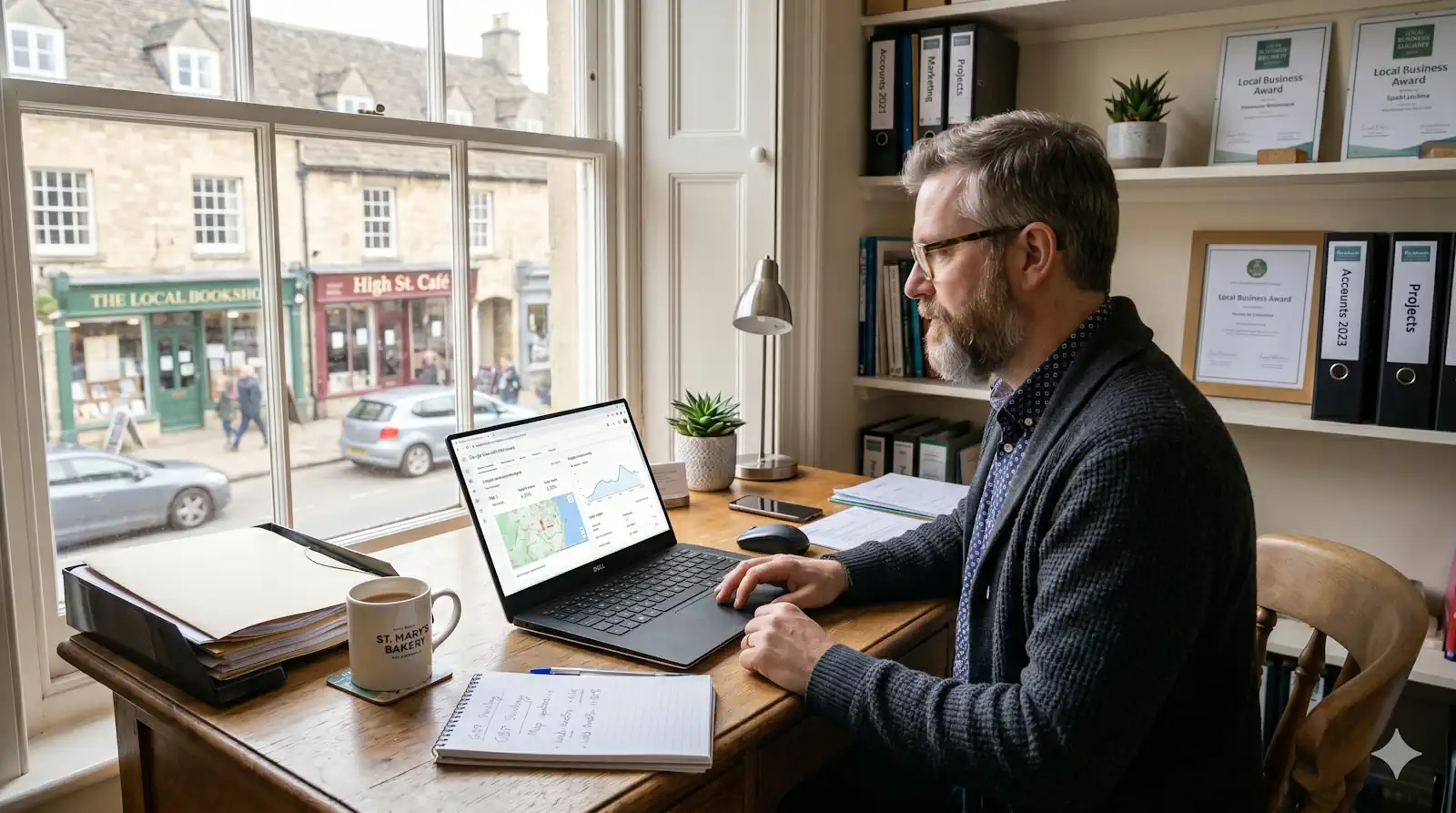
Local business owners are often given too many marketing numbers and not enough useful guidance. Website visits, impressions, clicks, calls, map views, keyword positions, social reach, AI mentions, review scores and conversion rates can all appear important. The problem is that many of these figures only become useful when they help you make a better decision.
In 2026, local visibility is no longer just about where your website ranks for one search phrase. Customers may find you through Google Search, Google Maps, your Google Business Profile, local directories, review sites, social platforms, voice search and AI-generated answers. That means the metrics you track need to reflect how people actually discover and choose local businesses.
This article looks at the practical numbers worth paying attention to, and how to use them without getting lost in reports.
Start with the business outcome, not the dashboard
The best place to start is not Google Analytics, Search Console or your Google Business Profile dashboard. It is your business goal.
For most local businesses, the aim is usually one or more of the following:
- More qualified phone calls
- More enquiry form submissions
- More bookings or appointments
- More visits to a physical location
- More repeat customers
- Better quality enquiries from the right areas
Once you are clear on the outcome, the metrics become easier to judge. A number matters if it helps you understand whether your visibility is leading to real enquiries, sales or visits. A number is less useful if it looks impressive but does not connect to customer action.
For example, a blog post that brings in thousands of visitors from outside your service area may look good in a report. But if none of those visitors become customers, it may be less valuable than a small service page that brings in five strong local enquiries each month.
Local impressions still matter, but only with context
Impressions show how often your business or website appears in search results. They are useful because they tell you whether Google is showing you for relevant searches. However, impressions on their own do not prove that your marketing is working.
A local electrician in Cardiff might receive more impressions after adding useful pages for emergency call-outs, rewires and consumer unit upgrades. That is a positive sign if the searches are relevant and within the areas the business serves. But if impressions rise because the site is appearing for vague informational searches from all over the country, the value is lower.
When reviewing impressions, ask:
- Are these searches connected to the services we actually provide?
- Are they coming from the towns, cities or regions we serve?
- Are impressions increasing for pages that can generate enquiries?
- Do impressions eventually lead to clicks, calls or visits?
Impressions are a visibility signal. They are not the final result.
Clicks are useful, but not all clicks are equal
Clicks tell you that someone chose to visit your website or profile after seeing you in search. That matters, but you still need to look at the quality of those clicks.
A good local click usually has some buying or enquiry intent. It might come from a search such as “accountant near me”, “kitchen fitter in Newport”, “family solicitor in Swansea” or “dog groomer open Saturday”. These searches suggest the person is looking for a provider, not just browsing.
Lower quality clicks may come from broad advice searches, job seekers, competitors or people outside your area. They are not always useless, but they should not be treated the same as a potential customer looking for a local service.
To understand click quality, review which pages people land on. Service pages, location pages, contact pages and booking pages are often more commercially useful than general articles. Good content can support your authority, but your core service pages need to do the heavy lifting when it comes to enquiries.
Google Business Profile actions are essential for local firms
For many UK local businesses, the Google Business Profile is one of the most important visibility assets. People may call, ask for directions, view photos, read reviews or visit your website directly from the profile without ever browsing the full site first.
Useful profile metrics include:
- Phone calls from the profile
- Website clicks from the profile
- Direction requests
- Bookings or appointment actions, where available
- Search terms people used before finding the profile
- Photo views and engagement
These figures help you understand how visible and useful your profile is. If direction requests are rising, that may be a strong sign for a shop, clinic, café or showroom. If calls are increasing, that may be more important for trades, professional services or urgent local help.
Do not only check whether your profile has been viewed. Look at what people did next. A profile that gets fewer views but more calls may be more valuable than one with lots of passive views.
Calls and enquiries should be tracked carefully
Phone calls and enquiry forms are closer to the money than impressions or clicks. They show that someone took action. However, they still need a little care.
It is worth noting where enquiries come from, what service they relate to, and whether they are a good fit. You do not need a complicated system to start. A simple spreadsheet can be enough for many small businesses.
Track details such as:
- Date of enquiry
- Source, if known
- Service requested
- Location of the customer
- Whether the enquiry was suitable
- Whether it became a booking, sale or quote
This helps you see which areas of your visibility are producing useful leads, not just activity. If you want better decisions, the quality of enquiries matters as much as the quantity.
Reviews are both a trust signal and a visibility signal
Reviews affect how people choose local businesses. They can also support your wider local presence when they mention services, locations and customer experience naturally.
The most useful review metrics are not just the star rating. Look at:
- How recently reviews have been added
- Whether reviews mention specific services
- Whether reviews mention local areas
- How you respond to reviews
- Whether review themes match what you want to be known for
A steady flow of genuine reviews is often more reassuring than a sudden burst followed by silence. Customers want to see that your business is active, trusted and consistent.
Reviews also help build Visibility and Authority. When customers repeatedly describe your work clearly, it reinforces what your business does and where it operates.
AI search visibility needs practical measurement
AI search is changing how people discover businesses. Some users now ask tools for recommendations, comparisons or explanations before visiting a website. This does not mean traditional SEO is no longer relevant. It means your online presence needs to be clear, consistent and well supported across multiple sources.
AI systems often rely on information from websites, business profiles, reviews, directories and trusted sources. If your business details are inconsistent, thin or unclear, you may be harder to understand and recommend.
Useful AI visibility checks include:
- Does your website clearly explain who you help, what you do and where you work?
- Are your service pages detailed enough to answer common customer questions?
- Is your business information consistent across the web?
- Do reviews and third-party mentions support your main services?
- Can someone quickly understand why they should contact you?
This is where AI and Local Visibility overlap. The clearer your business is to customers, the clearer it is likely to be to search systems as well.
This article is based on the ideas discussed in the embedded video, with added UK local business context and practical guidance for business owners.
Keyword rankings are still useful, but they are not the whole picture
Many business owners still ask, “Where do I rank?” It is a fair question, but it needs context. Rankings can vary by location, device, search history, map results, adverts, AI summaries and personalisation.
Instead of relying on one keyword position, look at groups of relevant searches. For example, a local builder may want to understand visibility across extensions, loft conversions, renovations and garage conversions in several nearby towns.
This gives a more realistic picture than tracking one phrase. It also helps you spot service gaps. If you are visible for general building work but not for a profitable specialist service, that may guide your next content or profile update.
Engagement on key pages can show where customers hesitate
Website engagement metrics can help you improve your pages. If people arrive on an important service page and leave quickly, the page may not answer their questions. It may lack trust signals, clear service details, local relevance or a simple next step.
Useful things to review include:
- Which pages lead to enquiries
- Which pages attract visitors but no action
- Whether contact details are easy to find
- Whether pages explain pricing, process or service areas where appropriate
- Whether calls to action are clear but not pushy
Small improvements can make a difference. Adding clearer service information, examples of work, FAQs, review snippets or stronger local wording can help visitors feel more confident.
Measure consistency across your local presence
Local visibility is not built from one platform alone. Your website, Google Business Profile, reviews, directories and social profiles should all tell the same story.
At least a few times a year, check:
- Business name, address and phone number consistency
- Opening hours, including bank holidays where relevant
- Service lists and descriptions
- Website links from profiles and directories
- Photos and branding
- Old or duplicate listings
Inconsistent details can confuse customers and search systems. Keeping information accurate is not glamorous work, but it supports trust and reduces friction.
Create a simple monthly visibility report
You do not need a complex report to make better marketing decisions. For many local businesses, a one-page monthly review is enough.
Include the following:
- Website enquiries and calls
- Google Business Profile calls, website clicks and direction requests
- Top performing service or location pages
- Search queries showing useful growth
- New reviews and review themes
- Any visibility gaps or weak services
- Actions to take next month
The final point is the most important. A report should lead to action. If it does not help you decide what to improve, simplify it.
Focus on decisions, not vanity numbers
The metrics that matter in 2026 are the ones that help you understand visibility, trust and customer action. More data is not always better. Better interpretation is what helps.
For a local business, the key questions are straightforward:
- Are the right people finding us?
- Are they finding us in the right locations?
- Do they understand what we offer?
- Do they trust us enough to make contact?
- Which pages, profiles or searches are producing real opportunities?
If you can answer those questions each month, you will have a clearer view of your marketing than many businesses with much bigger reports.
If you would like help reviewing which visibility metrics matter for your business, you can Contact Barrie Evans Marketing for a practical discussion.
Useful Related Pages
Related Articles

Using AI Images and Thumbnails to Improve Local Business Visibility
AI image tools can help local businesses create clearer thumbnails, service images and promotional visuals. The key is using them with purpose, not as a replacement for real trust signals.
Choosing the Right AI Tool for Local Business Visibility
AI tools can help local businesses save time, improve content and support visibility, but the tool matters less than how you use it. Here is a practical way to choose the right AI assistant for your business.