
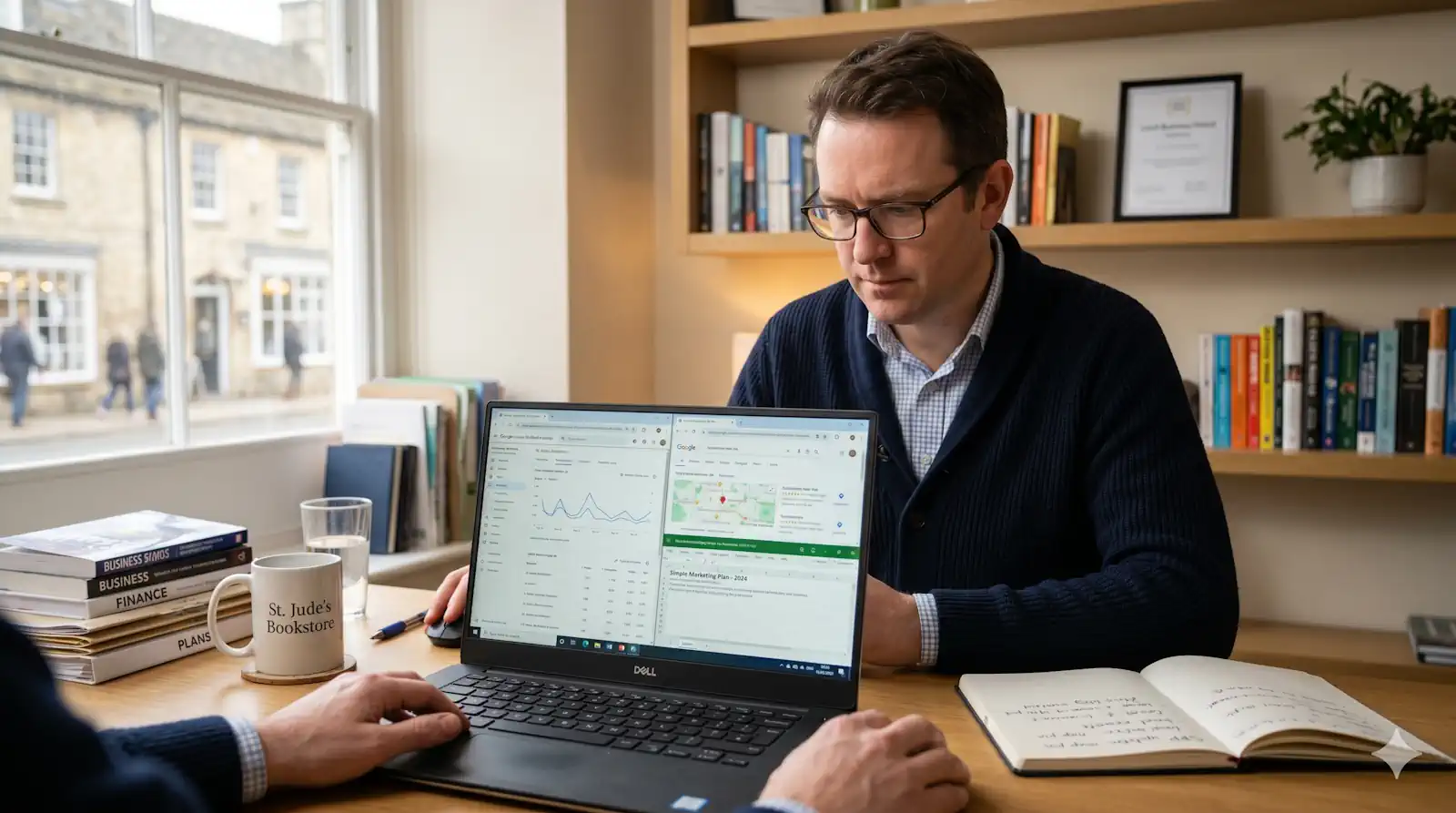
When people hear about a large company’s marketing strategy, it is easy to assume it has nothing to do with a local plumber, accountant, solicitor, builder, clinic, restaurant or independent retailer. The budgets are different. The teams are different. The tools are different.
But some of the thinking behind larger marketing plans is very useful for smaller UK businesses. Not because you need to copy the scale, but because you can copy the discipline. Clear messaging, useful content, strong proof and consistent visibility matter whether you serve one town or the whole country.
This article looks at how a local business can take the sensible parts of a bigger marketing approach and apply them without making marketing complicated.
Start with the problem your customer already understands
Many local businesses describe themselves by what they do. That is natural, but it is not always the best starting point for marketing. A customer usually begins with a problem, a frustration or a job that needs doing.
For example, a business might say it offers accountancy services. A better starting point could be the customer’s actual situation: they are worried about tax deadlines, unsure what they can claim, or tired of not knowing whether their business is profitable.
A roofer might say they repair flat roofs. The customer may be searching because there is a leak above the kitchen, damp on the ceiling, or they have been let down by another contractor.
Good marketing begins by making the customer feel understood. This helps with your website, your Google Business Profile posts, your service pages, your FAQs and your sales conversations. It also helps AI search tools understand what your business is relevant for, because your content reflects real questions and situations rather than vague descriptions.
Make your positioning easy to repeat
A strong marketing message should not need a long explanation. If your best customer had to describe your business to a friend, what would you want them to say?
Local businesses often make this too broad. Phrases such as “high quality service” and “customer focused” are not wrong, but they are used so often that they become invisible. A clearer message is more specific.
Examples might include:
- a family-run electrician specialising in older homes in South Wales
- a bookkeeping service helping tradespeople keep on top of cash flow and VAT
- a dental practice focused on nervous patients and clear treatment plans
- a commercial cleaner working with small offices, clinics and local professional firms
This sort of positioning is easier for people to remember. It is also easier for Google, Maps and AI systems to connect with the right searches. If your business is hard to describe, it is harder to recommend.
Build content around buying questions, not just keywords
Search engine optimisation still matters, but local SEO is not just about placing keywords on a page. A useful approach is to list the questions customers ask before they decide to contact you.
These may include:
- How much does it cost?
- How long does the work take?
- Do I need a repair or a replacement?
- What should I check before choosing a provider?
- What happens during the first appointment?
- Which areas do you cover?
Each of these questions can become a section on a service page, a blog article, a short video, or a Google Business Profile update. This is useful because it supports the way people actually make decisions. It also gives search engines more context about your expertise.
If you are thinking about how this connects with modern search behaviour, the AI and Local Visibility section covers this in more detail. AI search tools tend to favour clear, useful and well-structured information, especially when it answers a real user need.
Use proof that reduces doubt
Marketing is not only about being found. It is also about helping someone feel confident enough to get in touch. Proof plays a big part in that.
For a local business, proof can be simple. You do not need glossy campaigns or long case studies for every job. You need evidence that shows you are real, reliable and suitable for the customer’s situation.
Useful proof may include:
- recent reviews that mention specific services or locations
- before and after examples where appropriate
- short explanations of how you solved a customer’s problem
- photos of your team, premises, vehicles or completed work
- clear accreditations, insurance details or professional memberships
- answers to common concerns, such as timing, disruption, cost or aftercare
This sort of content helps potential customers and also strengthens your wider visibility. Your Google Business Profile is one of the best places to show this proof, because it often appears when people are close to making a decision.
This article is based on the ideas discussed in the embedded video, with added UK local business context and practical guidance for business owners.
Think like a helpful guide, not a loud advertiser
One useful lesson from larger marketing strategies is that the best content often helps customers understand the category, not just the brand. For a local business, this means explaining the choices your customer faces.
A heating engineer might explain when a boiler repair is sensible and when replacement may be better. A solicitor might explain the steps in a conveyancing process. A care provider might explain what families should ask before choosing support for an elderly relative.
This does not mean giving away everything for free. It means giving enough clarity for the right customer to trust you. People do not usually contact a business because it kept them confused. They contact a business because it made the next step feel clearer.
This approach also supports Visibility and Authority. When your website and business profiles show useful knowledge, you are building more than traffic. You are building confidence.
Connect your website, Google profile and local presence
A common problem for local businesses is that their marketing assets do not support each other. The website says one thing, the Google profile says another, and social media posts are not linked to the services that matter most.
You do not need a large system to fix this. Start by choosing your main services and making sure each one is clearly represented across your key visibility points.
Check the following:
- Your main service pages explain who the service is for, what problem it solves, where you provide it and what happens next.
- Your Google Business Profile categories, services, description, photos and updates match what you actually want to be found for.
- Your reviews mention real services, outcomes and locations where possible.
- Your blog or advice content links naturally to relevant service pages.
- Your contact details, opening hours and service areas are consistent.
This makes your business easier to understand. It also reduces friction for the customer. If someone finds you in Maps, visits your website, reads a review and checks your services, the story should feel consistent.
Create one strong content asset at a time
Local business owners are busy. A practical marketing strategy should respect that. Instead of trying to publish constantly, focus on creating one genuinely useful content asset at a time.
For example, you could create a detailed page or article answering a common buying question. Then you can reuse the same idea in smaller ways:
- turn key points into a Google Business Profile update
- use one section as a short social post
- record a simple video answering the same question
- add the answer to a service page FAQ
- send it to a customer who asks the same question by email
This is how small businesses can get more value from their knowledge. You are not trying to produce content for the sake of it. You are building a useful library that supports search visibility, sales conversations and customer trust.
Measure whether your marketing is making decisions easier
It is sensible to track enquiries, calls, form fills, direction requests and website traffic. But there is another question worth asking: is your marketing making the customer’s decision easier?
Look at the quality of enquiries you receive. Are people asking more informed questions? Are they clearer about the service they need? Are fewer people confused about your prices, process or service area? These are useful signs that your message is improving.
You can also review which pages people visit before contacting you, which Google Business Profile actions are increasing, and which review themes keep appearing. These clues show what customers value and where your content may need to be clearer.
A simple way to begin
If you want to apply this thinking without overcomplicating your marketing, start with one service you want more of. Write down the real questions customers ask, the doubts they have, the proof they need and the local areas you want to serve.
Then update one page, improve one part of your Google Business Profile, and create one useful piece of content around that service. Small, consistent improvements are often more realistic than a complete marketing overhaul.
Large companies may use bigger budgets and more complex systems, but the core idea is still practical for a local business: be clear, be useful, show proof and make it easy for the right customer to choose you.
Useful Related Pages
Related Articles

Using AI Images and Thumbnails to Improve Local Business Visibility
AI image tools can help local businesses create clearer thumbnails, service images and promotional visuals. The key is using them with purpose, not as a replacement for real trust signals.

Choosing the Right AI Tool for Local Business Visibility
AI tools can help local businesses save time, improve content and support visibility, but the tool matters less than how you use it. Here is a practical way to choose the right AI assistant for your business.