
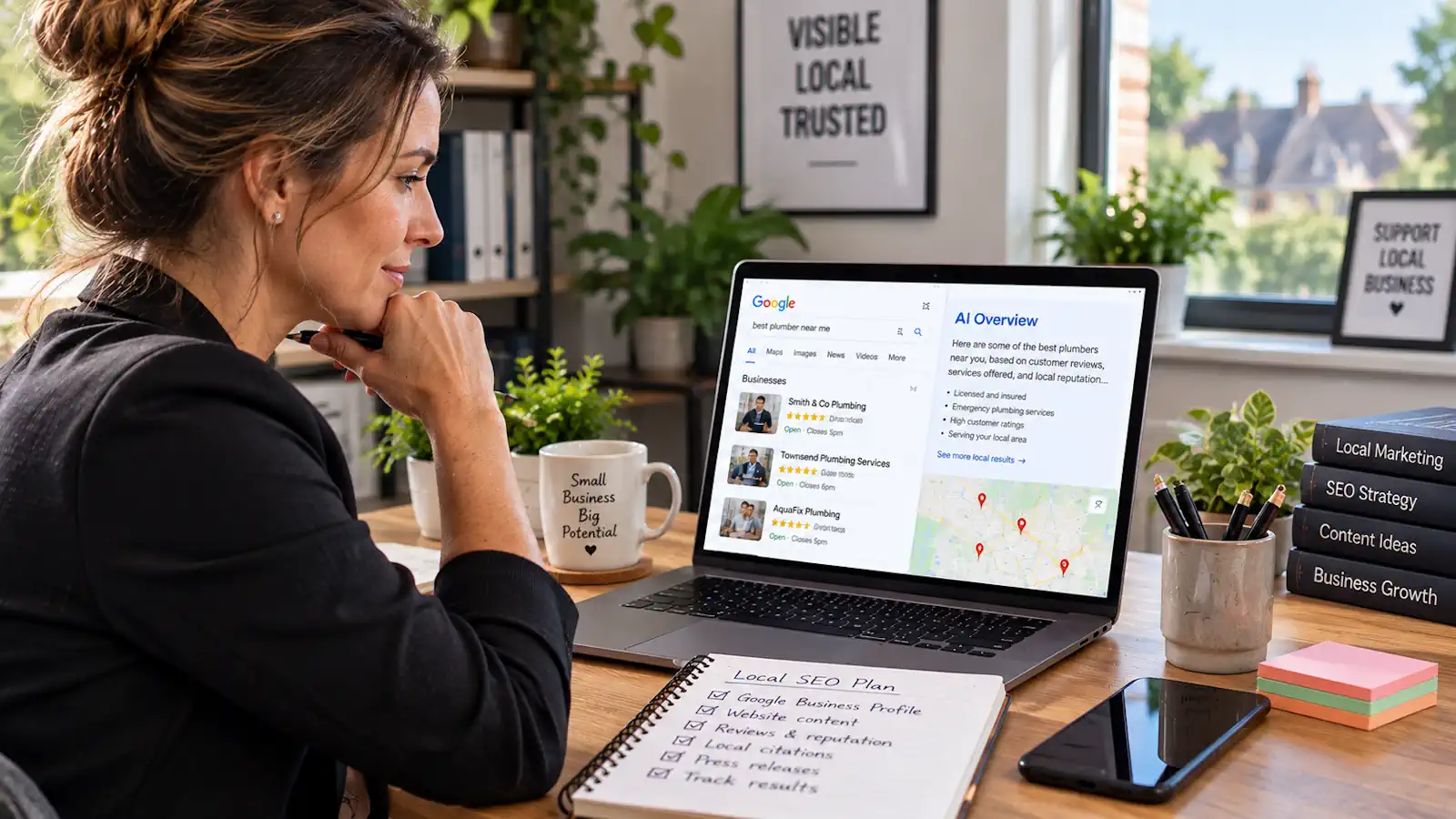
For many local businesses, the old search journey was fairly simple. Someone had a problem, typed a few words into Google, clicked a few websites, checked reviews, then made an enquiry.
That journey still exists, but it is no longer the only one. AI search tools, AI summaries, voice assistants and smarter search results are changing how people gather information before they contact a business.
This matters for plumbers, accountants, estate agents, clinics, trades, consultants, restaurants and other local firms across the UK. Your potential customer may now ask a detailed question and receive a shaped answer before they ever visit your website. They may compare options without clicking ten blue links. They may see your business mentioned, ignored, or misunderstood depending on how clear and consistent your online presence is.
The practical question is not whether AI search is good or bad. The useful question is: how do you make your business easier to understand, trust and recommend across modern search experiences?
The buyer journey is becoming less linear
Local customers rarely move in a neat straight line. A homeowner may start by asking, “Why is my boiler losing pressure?” before searching for a Gas Safe engineer nearby. A business owner may ask what bookkeeping software they need before looking for an accountant. Someone with back pain may research causes, treatment options and reviews before choosing a local clinic.
AI search encourages this behaviour because it allows people to ask broader, more conversational questions. Instead of typing “solicitor near me”, they may ask, “What should I look for when choosing a family solicitor in Cardiff?” or “How much does conveyancing usually cost in England?”
That means your business visibility is no longer only about appearing for one obvious keyword. You need to be present around the questions, concerns and comparisons that happen before the customer is ready to buy.
This is where AI and Local Visibility becomes important. AI systems look for clear information, trusted sources and useful explanations. If your online presence only says what you sell, but not who it helps, where you work, what problems you solve and why you are credible, you may be harder for both people and AI tools to understand.
AI search rewards clarity, not cleverness
Some business owners worry that they need to write in a technical way to be found in AI search. In most cases, the opposite is true.
Clear, specific and helpful content is more useful than vague marketing language. A local customer wants to know whether you are right for their situation. AI systems also need enough plain information to connect your business with the right questions.
For example, “We offer professional solutions for homes and businesses” is not very helpful. “We repair and service domestic boilers in Newport, including annual servicing, fault finding and emergency call-outs” is much clearer.
Good local visibility depends on answering basic questions well:
- What services do you provide?
- Who are they for?
- Which locations do you cover?
- What common problems do you solve?
- What qualifications, experience or proof support your claims?
- What should someone do next if they need help?
This does not mean stuffing pages with place names or repeating keywords unnaturally. It means describing your work in the language your customers actually use.
Your Google Business Profile still matters
AI search may feel new, but the foundations of local visibility have not disappeared. For many UK local businesses, Google Business Profile remains one of the most important assets online.
Your profile helps people find you in Google Search and Google Maps. It can also support wider trust signals when your business information is consistent across the web.
A well-maintained Google Business Profile should include accurate contact details, the right categories, clear services, service areas where relevant, opening hours, photos and regular updates. Reviews are also important, not just for ratings, but because they often contain natural language about the work you do and the locations you serve.
If your profile is thin, out of date or inconsistent with your website, it creates friction. People may hesitate. Search systems may have less confidence. AI tools may find it harder to describe your business accurately.
For many businesses, improving visibility starts with the basics: make sure Google, your website and your other online listings all tell the same story.
Customers are doing more research before they enquire
AI search can make people feel more informed before they speak to you. This can be positive. A customer who understands the issue may ask better questions and be more ready to proceed.
However, it also means your website needs to do more than act as an online brochure. It should help people make sense of their options.
Think about the questions you answer every week on phone calls, in emails or during consultations. Those questions are content opportunities. If customers often ask about prices, process, timescales, materials, qualifications, guarantees or what to expect, you should consider answering those topics clearly on your website.
You do not need to reveal every commercial detail. You do need to reduce uncertainty. A vague page can make people leave and continue researching elsewhere. A useful page can keep them with you longer and build confidence.
Practical content ideas include:
- A service page that explains what is included and who it is suitable for.
- A location page that explains your local coverage in a natural way.
- A frequently asked questions section based on real customer queries.
- A comparison article that helps people understand different options.
- A short guide explaining your process from enquiry to completion.
Trust signals need to be easy to find
In local services, trust is often the deciding factor. AI search may help people shortlist options, but the customer still needs to feel comfortable making contact.
Your trust signals should not be hidden away. If you have qualifications, memberships, insurance, case studies, reviews, years of experience, local knowledge or specialist expertise, make these visible where they matter.
For example, a care provider should make safeguarding, inspection details and service standards easy to understand. A tradesperson should make relevant accreditations clear. A consultant should explain their experience and the types of clients they support.
Trust is also built through consistency. If your website says one thing, your Google profile says another, and your social media has not been updated for years, customers may be unsure whether the business is active or reliable.
This is where local visibility overlaps with reputation. You are not only trying to be found. You are trying to be chosen.
This article is based on the ideas discussed in the embedded video, with added UK local business context and practical guidance for business owners.
How to adapt your website for AI-influenced search
You do not need to rebuild your entire website to respond to AI search. In many cases, the best improvements are practical and gradual.
Start with your core service pages. Each important service should have its own clear page where possible. Avoid squeezing everything into one short list. A dedicated page gives you room to explain the problem, your approach, locations served, common questions and next steps.
Use natural headings and plain wording. If someone asks an AI tool a question, the answer may be built from pages that explain topics clearly. Write for people first, but make the page structured enough for search engines and AI systems to understand.
Make your location information specific, but sensible. If you serve several towns, say so. If you have a physical premises, make the address and contact details clear. If you visit customers, explain your service area without creating low-quality duplicated pages for every nearby village.
Add useful proof. This could include brief examples of work, customer comments, before-and-after explanations where suitable, accreditations or photos. The aim is to show that your business is real, active and capable.
Practical steps you can take this month
If you want to improve your visibility in a way that supports both traditional Google search and AI-influenced discovery, begin with a simple review.
- Check your business details. Make sure your name, address, phone number, opening hours and website are consistent across your main online profiles.
- Review your Google Business Profile. Check categories, services, photos, reviews and updates. Remove outdated information.
- Improve one key service page. Add clearer explanations, common questions, locations covered and trust signals.
- Write down real customer questions. Use sales calls, emails and enquiries to identify topics your website should answer.
- Ask for reviews in a steady, honest way. Reviews help people understand what it is like to work with you.
- Make contact routes obvious. Phone, email, forms and booking options should be easy to find on important pages.
None of this requires hype or shortcuts. It requires making your business easier to understand and easier to trust.
Do not chase every AI trend
There will be plenty of noise around AI search. New tools will appear. Search result layouts will change. Advice will often sound more complicated than it needs to be.
Local business owners should avoid reacting to every new tactic. The stronger approach is to build a clear and credible online presence that can work across different platforms.
That means useful website content, an accurate Google Business Profile, consistent local information, genuine reviews and clear proof of expertise. These foundations support Google visibility today and make your business easier for AI systems to interpret tomorrow.
If you are unsure where your visibility is weak, it can help to get an outside view. You can Contact Barrie Evans Marketing to discuss where your local search presence stands and what practical improvements are worth prioritising.
The main point for local businesses
AI search is changing how buyers research, compare and decide. It does not remove the need for local SEO, good content or a well-managed Google Business Profile. It makes those things more important because customers now gather information from more places before they contact you.
The businesses most likely to benefit are not necessarily the loudest. They are the ones that explain what they do clearly, show genuine trust signals, answer useful questions and keep their online information consistent.
If your business can be easily understood by people, Google and AI search tools, you are in a stronger position to be found and considered when local customers are ready to act.
Useful Related Pages
Related Articles

How Customer Questions Can Improve Your AI Search Visibility
The questions customers ask during calls, quotations and appointments can provide some of the most useful subjects for website content and videos.

What Makes a Local Business a Trustworthy Source for AI?
AI systems need more than promotional claims. Clear ownership, consistent details, genuine reviews and independent evidence create a stronger picture of a local business.