
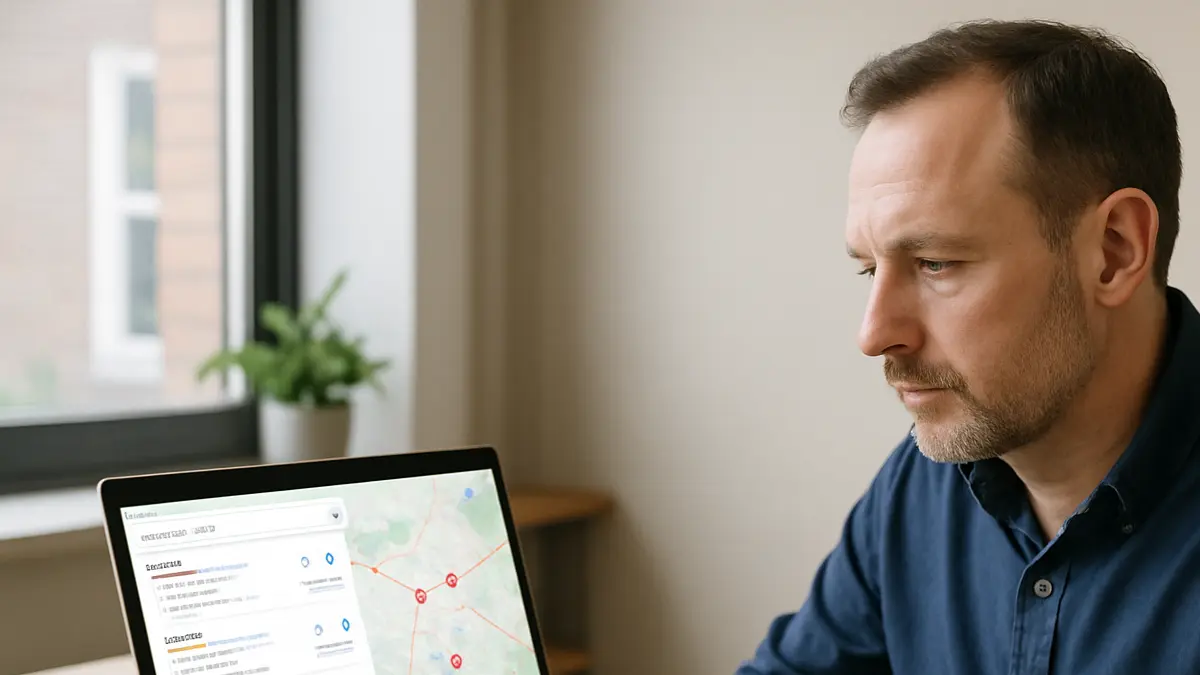
Local SEO can feel more complicated than it needs to be. Many UK business owners know they should be visible on Google, Google Maps and their Google Business Profile, but they are not always sure what matters most or where to start.
The good news is that local SEO is not about chasing every new tactic. It is about making your business easy to understand, easy to trust and easy to choose. Google needs clear signals. Customers need confidence. AI search tools increasingly need reliable information they can recognise and repeat.
This article sets out the essentials in plain English. It is written for local businesses such as trades, clinics, professional services, shops, hospitality venues and service-area businesses that want more relevant local enquiries without relying on guesswork.
Local SEO starts with clarity
Before you think about rankings, reviews or posts, start with the basics. Can someone quickly understand what you do, where you do it and who you help?
This sounds obvious, but many local business websites and profiles are too vague. They use broad phrases such as “quality solutions” or “professional services” without saying the actual service, location or customer problem.
A clear local SEO foundation includes:
- Your main services described in simple language.
- Your town, city, county or service area stated clearly.
- A consistent business name, address and phone number where relevant.
- Clear opening hours or enquiry times.
- Evidence that the business is active and legitimate.
Google is trying to match searches with useful local results. If your information is unclear, incomplete or inconsistent, you make that job harder. A competitor with clearer signals may be easier for Google to understand, even if your business is better in real life.
Your Google Business Profile is not a one-off task
For many local searches, your Google Business Profile is the first thing people see. It may appear before your website, especially on mobile searches and in Google Maps. That means it should be treated as a working business asset, not something you set up once and forget.
At a minimum, check that your profile has the correct primary category, relevant secondary categories, accurate contact details, a helpful business description and current opening hours. Add services, products or menu items where suitable. Use real photos that help people understand your premises, team, work, vehicles, equipment or results.
If you need a structured way to review the basics, the Google Business Profile Optimisation Guide is a useful place to start.
One common mistake is only updating the profile when something goes wrong. A better approach is to keep it current. Add new photos, answer questions, respond to reviews and publish useful updates when you have something worth saying.
Local relevance comes from your website too
Your website still matters. Your Google Business Profile may be the shop window, but your website helps support your authority, explain your services and provide more detail than a profile listing can hold.
Each important service should have a clear page where possible. That page should explain what the service includes, who it is for, where you provide it and what the customer should expect. Avoid writing pages only for search engines. Write them for real customers, then make sure the search engines can understand them.
For example, a plumber in Cardiff should not rely on one short homepage that says “all plumbing work undertaken”. It would be more useful to have clear pages for emergency plumbing, boiler repairs, bathroom plumbing and commercial plumbing if those are real services offered. Each page can then include sensible local context without forcing location names into every sentence.
Local SEO improves when your website, Google Business Profile and wider online presence all tell the same story.
Trust signals make a real difference
Visibility is not only about being found. It is also about being chosen. When someone sees your business in local results, they are often comparing you with several other options. Trust signals help them decide whether to click, call or move on.
Useful trust signals include:
- Recent, genuine reviews from customers.
- Thoughtful replies to reviews, including less positive ones.
- Photos that look real rather than generic.
- Clear details about qualifications, memberships or experience.
- Case studies, project examples or before-and-after work where appropriate.
- Consistent information across directories, social profiles and your website.
Reviews are particularly important because they help both people and platforms assess your business. You do not need perfect reviews. In fact, a natural review profile usually looks more trustworthy than one that feels too polished. What matters is that reviews are genuine, relevant and handled professionally.
Authority is built over time
Local visibility is easier when your business has evidence around it. This might include local press mentions, useful website content, business directory listings, supplier pages, community involvement, trade associations, case studies or helpful guides.
These signals help build a broader picture of your business online. They show that your business exists beyond one website and one Google profile. This is especially important as search results become more blended, with Google, Maps and AI-led answers drawing on different sources.
If you want to understand this wider approach, the Visibility And Authority page explains how stronger signals can support local discovery and trust.
Authority should not be confused with noise. Posting everywhere without a plan does not automatically help. A small number of clear, consistent and credible signals is usually more useful than a scattered online presence that says different things in different places.
AI search is changing how local businesses are discovered
AI search tools and AI-generated summaries are becoming more common. Local business owners do not need to panic about this, but they should understand the direction of travel.
AI systems tend to rely on information they can identify, compare and trust. If your business has limited information online, inconsistent details or thin service pages, it may be harder for AI tools to mention you accurately. If your business has clear service information, strong local signals and reliable evidence, you give these systems more to work with.
This does not mean writing robotic content or filling your website with unnatural phrases. It means making your expertise easy to read and easy to verify. Explain your services clearly. Answer common customer questions. Keep your business details consistent. Show proof where possible.
The topic is covered further in Ai And Local Visibility, especially for businesses that want to understand how Google and AI search may overlap in local discovery.
This article is based on the ideas discussed in the embedded video, with added UK local business context and practical guidance for business owners.
A simple local SEO checklist
If you want to make steady progress, start with a manageable checklist rather than trying to fix everything at once. Local SEO is easier when it becomes part of normal business housekeeping.
- Check your business details. Make sure your name, address, phone number, website and opening hours are accurate wherever customers may find you.
- Review your Google Business Profile. Confirm your categories, services, description, photos and review responses are up to date.
- Improve your key website pages. Make sure your main services and locations are clear, useful and written for real customers.
- Ask for reviews consistently. Build this into your normal customer process rather than asking only when you remember.
- Add fresh evidence. Photos, project notes, useful updates and case studies can all help show that the business is active.
- Check your local mentions. Look at directories, social profiles, trade listings and any local coverage to make sure details are consistent.
- Measure enquiries, not vanity metrics. Track calls, forms, direction requests and good-quality leads, not just impressions.
You do not need to complete every item in one day. The aim is to reduce confusion and improve confidence over time.
Common local SEO mistakes to avoid
Some local SEO problems are not caused by a lack of effort. They are caused by effort being spent in the wrong places.
A few common mistakes include creating lots of near-identical location pages, copying content from competitors, using fake reviews, changing business categories too often, ignoring customer questions, or treating the Google Business Profile as less important than the website.
Another mistake is expecting one action to solve everything. Local SEO usually improves through a combination of clear information, technical health, reviews, useful content, local relevance and ongoing consistency. None of these needs to be dramatic, but together they can make your business easier to find and easier to trust.
What to focus on first
If you are short on time, start with the areas closest to the customer journey. Search for your own business name and main services. Look at what appears. Is your profile complete? Are your reviews recent? Does your website explain your services clearly? Are your contact details easy to find?
Then search like a customer would. Use service and location phrases. Look at the businesses that appear prominently. Do not copy them, but notice what Google is showing. Are they using stronger categories, clearer pages, better reviews or more helpful photos?
This simple review can show you where the gaps are. You may find that your business is good, but your online presence is not explaining it well enough.
Local SEO is practical, not mysterious
The essentials of local SEO are not hidden. Google wants to understand your business. Customers want confidence before they contact you. AI search tools need reliable information they can interpret. Your job is to make all of that easier.
Start with clarity. Keep your Google Business Profile active. Build useful website pages. Show evidence. Ask for reviews in a professional way. Keep your details consistent. Over time, these practical steps can support stronger local visibility and better-quality enquiries.
Local SEO works best when it reflects the real business behind the listing. The clearer and more credible that picture is, the easier it becomes for people to find you, understand you and choose you.
Useful Related Pages
- Visibility And Authority
- Visibility And Authority Support
- Press Coverage Business Announcements
- Authority Network System
- Google Business Profile
- Google Business Profile Support
- Google Ai Free Video
- Google Business Profile Optimisation Guide
- Google Posts For Local Businesses 2026
- Google Business Profile Insights Explained
- Google Business Profile Photos Guide
- Ai And Local Visibility
- Why Google And Ai Ignore Most Local Businesses
Related Articles

How to Check a Local Competitors Online Visibility Without Overcomplicating It
Learn how to review a local competitor’s online visibility in a simple, useful way so you can improve your own website, Google presence and authority.

Backlinks for Local Businesses: What Helps, What Does Not, and What to Avoid
Backlinks can support local visibility, but not every link is useful. Here is a practical guide for UK local businesses on building authority without falling for poor link-selling tactics.