
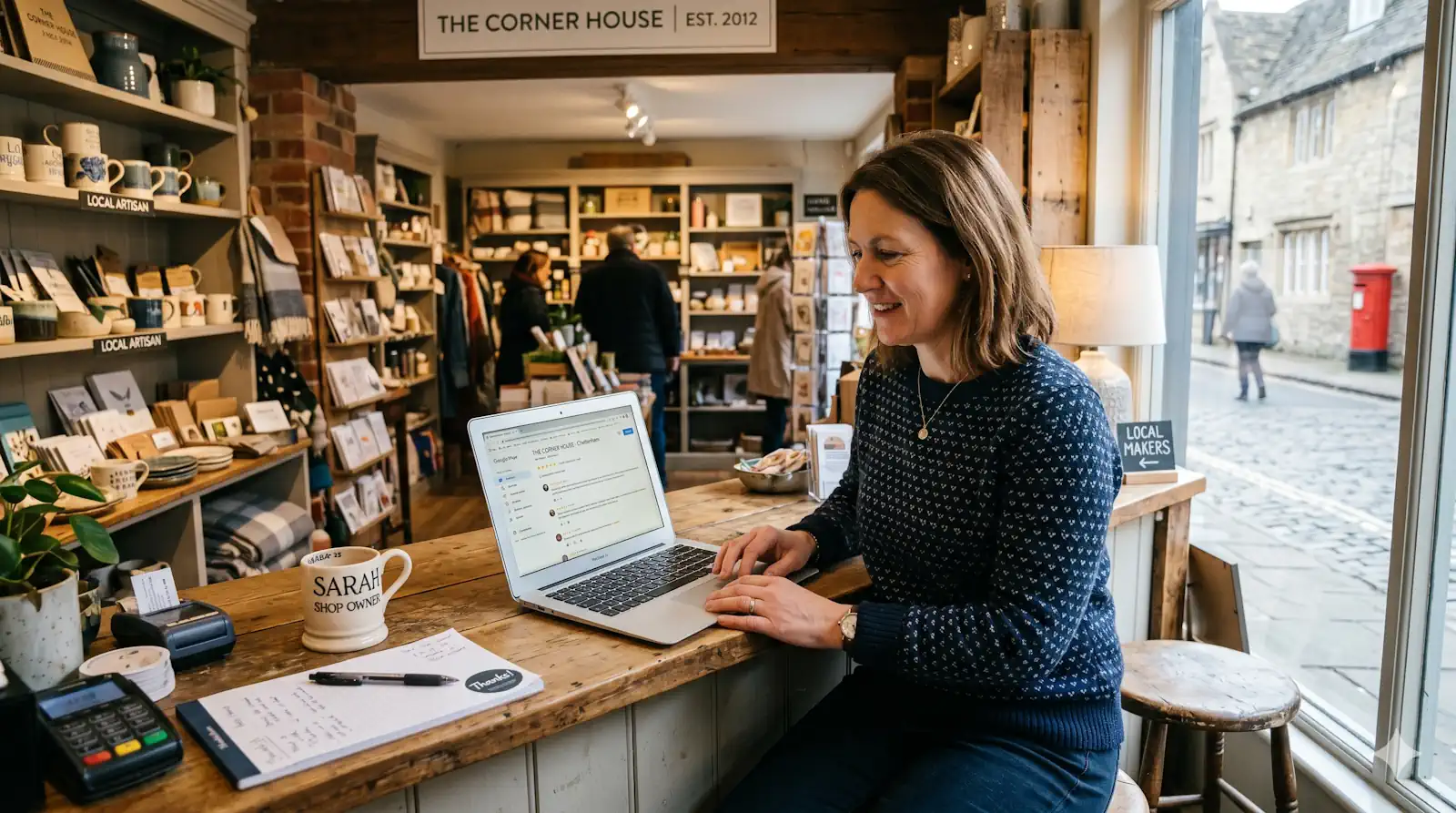
A customer finds your business on Google Maps, likes the look of your services, then pauses at the reviews. They are not only checking the star rating. They are looking at what people actually say, how recent the feedback is, and whether the business replies in a sensible way.
For many local businesses, reviews have become part of the first impression. They sit beside your opening hours, directions, photos and contact details. If they look neglected, the profile can feel less active. If they are helpful and genuine, they can support trust before anyone picks up the phone.
This does not mean chasing reviews at all costs. It means building a steady, honest review process that fits how your business already works.
Why reviews matter beyond the star rating
It is easy to focus on the average score, but reviews do more than show whether customers are happy. They give potential customers clues about the type of service they can expect.
A review that mentions punctuality, clear pricing, friendly staff, tidy work or helpful advice can answer questions that are already in a customer’s mind. This is especially useful for local services where people may be comparing several nearby options.
Reviews can also add context to your business listing. A garage, solicitor, plumber, café or dental practice may all benefit from reviews that describe specific services. This can make the profile feel more useful to people browsing in Google Search or Maps.
There are no guarantees that reviews alone will improve rankings. Local visibility depends on several factors, including relevance, distance, prominence, profile quality and competition. Even so, a healthy review profile is one of the clearest trust signals a potential customer can see.
Make review requests part of normal customer service
The best review systems are usually simple. They do not rely on a big campaign or a complicated process. They are built into everyday customer contact.
For example, a business might ask for a review after a job is completed, after an order is collected, after a consultation, or after a customer has expressed satisfaction. The timing matters. Asking too early can feel awkward. Asking too late means the customer may have moved on.
A polite request is often enough. You might say that reviews help local customers understand what to expect, and that you would appreciate honest feedback if they have a moment. Keep the wording natural and avoid pressure.
It also helps to make the process easy. Your Google listing provides a review link that can be shared by email, text message or in a follow-up message. The shorter the journey, the more likely a happy customer is to complete it.
Ask for honest detail, not perfect praise
Strong reviews are not always the longest reviews, but they usually contain useful detail. A short comment such as “great service” is still positive, but it gives the next customer little to work with.
Without telling people what to write, you can invite them to mention what they found helpful. For example, you might ask whether they would be willing to comment on the service, the communication, the result, or the part of the experience they valued most.
This is not about scripting reviews. Customers should always write in their own words. It is about helping them understand that specific feedback is useful to other people.
For UK local businesses, this can be particularly useful when you offer more than one service. A builder may want reviews that naturally mention extensions, repairs or renovations. A beauty clinic may receive comments about different treatments. A professional service firm may benefit from reviews that describe clarity, responsiveness or guidance.
Respond like a real person
Review responses are often overlooked. Many business owners reply to poor reviews but ignore the positive ones. Others use the same copy-and-paste line every time.
A good response does not need to be long. Thank the customer, refer briefly to the service if appropriate, and keep the tone calm. If the review mentions a staff member or a particular job, a short acknowledgement can make the reply feel more genuine.
For negative reviews, take a steady approach. Do not argue. Do not share private details. Acknowledge the concern, explain that you take feedback seriously, and invite the customer to contact you directly if the matter needs further discussion.
People reading reviews often pay attention to how a business behaves under pressure. A measured reply can help show that the business is professional, even when feedback is not ideal.
Keep your review activity consistent
A profile with no recent reviews can look quiet, even if the business is busy. This does not mean you need a flood of new reviews. A steady pattern is usually more realistic and easier to maintain.
Consistency comes from routine. Decide who asks for reviews, when they ask, and how the link is sent. If several people in the business deal with customers, make sure everyone understands the same approach.
It may also help to keep a simple note of review requests. You do not need anything complicated. The aim is to avoid forgetting and to make sure the process is fair and consistent.
Be careful not to ask only customers you believe will leave five stars. Selective review requesting can create a misleading picture and may cause trust issues. Honest feedback is more useful in the long term.
Use feedback to improve the business, not just the profile
Reviews are public, but they are also a useful source of customer insight. If several customers mention the same strength, that may be something to highlight in your services, website copy or photos. If the same concern appears more than once, it may point to a process that needs attention.
For example, repeated comments about helpful communication are worth noticing. So are comments about unclear parking, slow replies, confusing appointment times or difficulty finding the premises.
The strongest approach is to treat reviews as part of normal business improvement. They can support your Google Business Profile, but they can also help you understand what customers notice most.
This article is based on the ideas discussed in the embedded video, with added UK local business context and practical guidance for business owners.
Common review mistakes to avoid
Some review tactics can do more harm than good. They may look efficient at first, but they can weaken trust or create problems with platform rules.
- Offering rewards for reviews: Incentives can make feedback less trustworthy and may breach review policies.
- Asking for only positive reviews: Customers should be free to leave honest feedback, whether it is glowing, mixed or critical.
- Using fake or staff-written reviews: This is misleading and can damage credibility if noticed.
- Ignoring reviews for months: An unanswered review section can make the profile feel unattended.
- Replying defensively: Sharp or emotional responses can put off future customers, even if the business feels the review is unfair.
- Using identical replies: Repeated template responses can feel impersonal and may reduce the value of replying at all.
It is also worth avoiding bursts of unnatural activity. If a business suddenly receives a large number of reviews after a long quiet spell, it can look odd to customers. A regular, steady approach is usually more believable.
How reviews connect with Google Maps visibility
When people search locally, they often make quick decisions from the map results. They may compare star ratings, review count, distance, photos, categories and whether the listing appears active.
Reviews are only one part of Google Maps visibility, but they can influence how confident a customer feels about contacting you. A listing with clear information, relevant photos, accurate services and thoughtful reviews is usually more helpful than one that is thin or neglected.
Review content may also reflect the language customers use. If people naturally mention the services they received, that can make the listing more informative. This should happen naturally through genuine customer feedback, not through scripted phrases or keyword stuffing.
The aim is to make your local listing useful, accurate and active. Reviews support that aim when they are handled properly.
What this means for your business in 2026
Review building should not feel like a separate marketing task. It works best when it becomes part of how the business follows up with customers.
A practical review process for 2026 might include:
- Choosing the right moment to ask for feedback.
- Using your official Google review link.
- Asking politely, without pressure or incentives.
- Encouraging honest and specific comments.
- Replying to reviews in a calm, human way.
- Looking for patterns that can improve the customer experience.
This is not about trying to game the system. It is about making it easier for satisfied customers to share useful feedback, while showing future customers that the business is active and responsive.
A sensible next step
If your reviews are patchy, outdated or rarely answered, start with a small review tidy-up. Reply to recent feedback, check that your profile details are accurate, and make sure your team knows when and how to ask for reviews.
You may also want to look at the wider profile, not just the review section. Categories, services, photos, opening hours and website links all contribute to how useful your listing is.
If you would like a clearer view of how your business appears locally, a Local Visibility Check can help identify practical areas to improve without guesswork.
Related Articles
What Google's New Reviews Button Means for Local Businesses
Google reviews are becoming easier for customers to notice and use. Here is what local business owners should do to keep reviews working properly for visibility, trust and enquiries.
How Local Businesses Can Compete More Effectively in Google Maps
A practical guide for UK local businesses on improving Google Business Profile visibility, building trust, and competing more effectively in local search.